Global Trade
How to Find Buyers for Export: A Practical Guide
Sep 29, 2026
Global Trade
Compare company data providers by identity, coverage, sources and freshness. Use a practical checklist to choose evidence for buyer and supplier research.
October 6, 2026By Exim Agent7 min readView as Markdown

Company data providers help teams identify businesses, enrich account records and investigate potential trade partners. The useful choice depends on the question you need to answer: which legal entity is this, what does it do, where is the evidence, and how current is it?
For exporters, a large database is only a starting point. Compare providers using the same sample companies and the same evidence checklist before committing to a subscription. This guide explains the criteria to test, what different sources contribute, and how to turn a vendor demonstration into a practical decision.
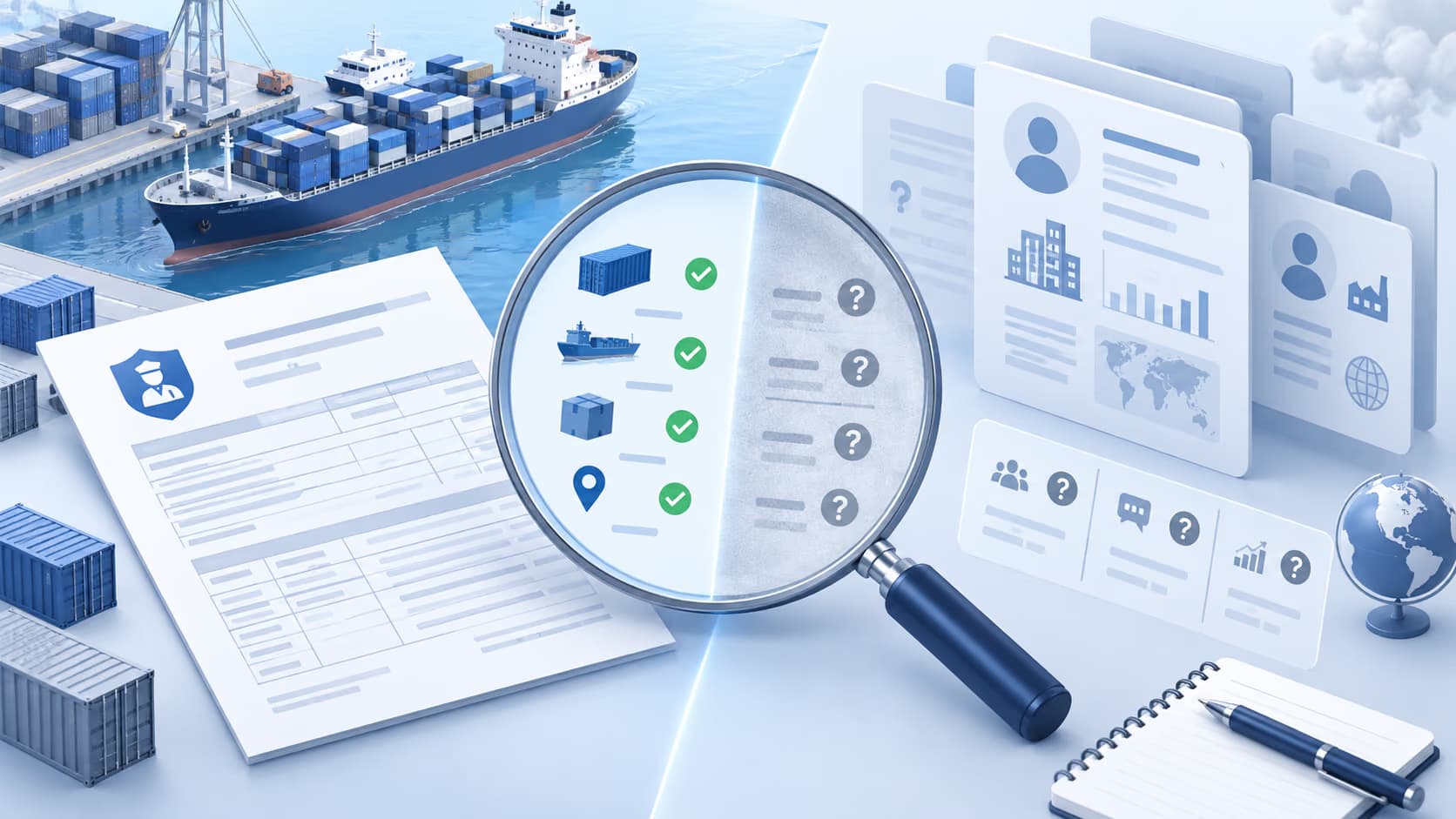
Company data usually includes firmographics such as business name, location, industry, website and estimated size. Some sources add corporate relationships, contacts or research summaries. These fields have different origins and verification standards; a populated field is not automatically a confirmed fact.
Keep company identity separate from buying activity. A company profile can help establish who a business is, while shipment records may support questions about historical trade. For that distinction, read our guide to trade data versus company databases.
Use identity sources to investigate registered names, addresses and identifiers. Check whether a record refers to a parent company, subsidiary or trading name. GLEIF explains how LEI reference data and accounting-parent relationships distinguish entity identity from ownership relationships. This is useful where an LEI record is available; it is not a substitute for researching every private business in your target market.
Evaluate these for structured account fields, market coverage and consistent exports. Ask which values are observed, supplied by the company, estimated or inferred. An employee estimate or industry label needs a source and date to be useful in qualification.
Websites can clarify products, locations and commercial positioning. Treat these as company statements until independently supported. Research services should make it easy to inspect the original material and preserve conflicting findings, rather than blending everything into one confident summary.
Use this comparison to decide which evidence to request. Coverage and available fields vary by jurisdiction and provider; these are source categories, not vendor rankings.
Source type | Useful for | Main limitation | Check before use |
|---|---|---|---|
Company registries and LEI records | Legal identity and recorded corporate relationships | Coverage and public fields vary; no proof of purchase intent | Entity identifier, jurisdiction, record date and relationship scope |
Commercial firmographic databases | Structured account enrichment and segmentation | Estimated or inferred fields may lack visible evidence | Sample accuracy, field provenance, update dates and export terms |
Company websites and research services | Products, locations and business context | Company statements may be incomplete or promotional | Original pages, observation dates and independent confirmation |
Shipment and trade records | Historical trade activity and recorded counterparties | Available markets and transport modes vary; activity does not prove current demand | Entity match, shipment period, coverage and record interpretation |

Test similar names, group structures and multiple locations. Ask how the provider matches your input to a specific entity and whether you can inspect the match. A plausible company with the wrong registration or domain can contaminate the entire account record.
Choose a test set from the countries, industries and company sizes you actually research. Include small firms and difficult cases, not only prominent multinational companies. Record missing fields and unsupported markets explicitly; an empty result does not establish that the company does not exist.
Request source references for identity, product descriptions and relationships. Distinguish parent ownership from supplier relationships and ordinary website mentions. A supplier claim should identify its supporting evidence and period, not merely appear as an unexplained connection.
Check when each material fact was observed or updated. A recently generated profile may contain older source records. Ask how changes in domains, locations, ownership or business activity are handled, and whether historical information remains identifiable.
Test a real export before buying. Confirm that identifiers, source references, dates and uncertainty notes survive the transfer to your working spreadsheet or CRM. Check available formats and access limits with the provider; do not assume that an API or a bulk export is included in every plan.
Ask for a written explanation of pricing units, refresh costs, export allowances and permitted downstream use. Calculate the cost of the research workflow you need, including manual review. A low cost per record can become expensive if most records require correction.
Start with a fixed sample, for example 20 companies from your target market. This is a suggested evaluation size, not an industry standard. Give each provider identical names and domains, then assess the returned records against known information and inspect the cited sources.
Keep factual checks separate from a preference score. Flag an unsupported identity match for review even if the profile looks complete. Record why a field failed and what additional evidence would resolve it.
Create one row for each company and provider in a spreadsheet. Record the input company name, domain, provider, review date and the fields below. Use Pass only when the evidence supports the field; use Review for unresolved or conflicting information and Missing when the provider returns no usable evidence.
Field to check | Evidence to record | Pass / Review / Missing |
|---|---|---|
Entity identity | Legal name, domain, identifier and original source URL | Pass only when the sources identify the intended company |
Product relevance | Product page or dated description supporting your target category | Review broad industry labels without product evidence |
Location and coverage | Location source and any market or field exclusions | Missing when the target location cannot be supported |
Relationships | Relationship type, counterparty, source and observation period | Review unexplained links or ambiguous entity matches |
Freshness | Source observation date for each important field | Review undated evidence or information outside your required period |
Export usability | Sample export retaining identifiers, source URLs and dates | Pass when required evidence survives the export |
Add a reviewer note explaining each unresolved field and the next check required. Compare providers by usable, supported results in your fixed sample, rather than counting filled cells alone.
Consider a fictional exporter evaluating two fictional sources for a packaging supplier. Source A fills every field but provides no reference for the company name or employee estimate. Source B has fewer fields but links the identity record and dates its product evidence. Neither is automatically the winner: Source A needs verification, while Source B may require supplementary research.
The decision depends on the missing information that matters to your job. For an initial sales conversation, product relevance and a supported entity match may be sufficient. For supplier approval, capacity, specifications and other procurement checks still need separate evidence. This illustration is not a measured customer result or a vendor benchmark.
Once you have a company to research, EximAgent's Company Intelligence workflow for trade partners documents entity resolution, company profiles, trade trajectories, customers, suppliers and shipment evidence. Use available records to investigate the company, then identify what still requires confirmation.
For the next step, follow our guide to researching an importing company before outreach. Keep the evidence and unanswered questions alongside your outreach notes so that your sales team can distinguish a finding from a hypothesis.
Try the workflow on one company: start with its name and, where available, website to clarify which entity you mean. Follow the Company Intelligence guide to investigate its profile and available trade evidence. Capture source references and dates in your worksheet, then flag missing or conflicting information before outreach.
Supported identity matches, coverage relevant to your market, traceable sources, meaningful update dates and a usable export matter more than the headline number of records.
No. A profile establishes research context. Historical activity and product fit can help qualify a prospect, but current demand requires further evidence and a conversation.
Only if your evaluation supports that choice. Identity, firmographics, contacts and trade evidence can require different sources. Make gaps visible instead of treating a single dataset as a complete answer.
Enter your email to receive the latest trade insights, guides, and HS-code explainers from EximAgent Blog.