Global Trade
04 Apollo.io Alternatives for Exporters: Real Prices Compared (2026)
Aug 18, 2026
Logistics
Learn what FCA Incoterms means, why it matters for exporters, and how to avoid the common mistakes. Compare FCA with DAP, DDP, EXW and CIF.
August 16, 2026By Exim Agent15 min readView as Markdown
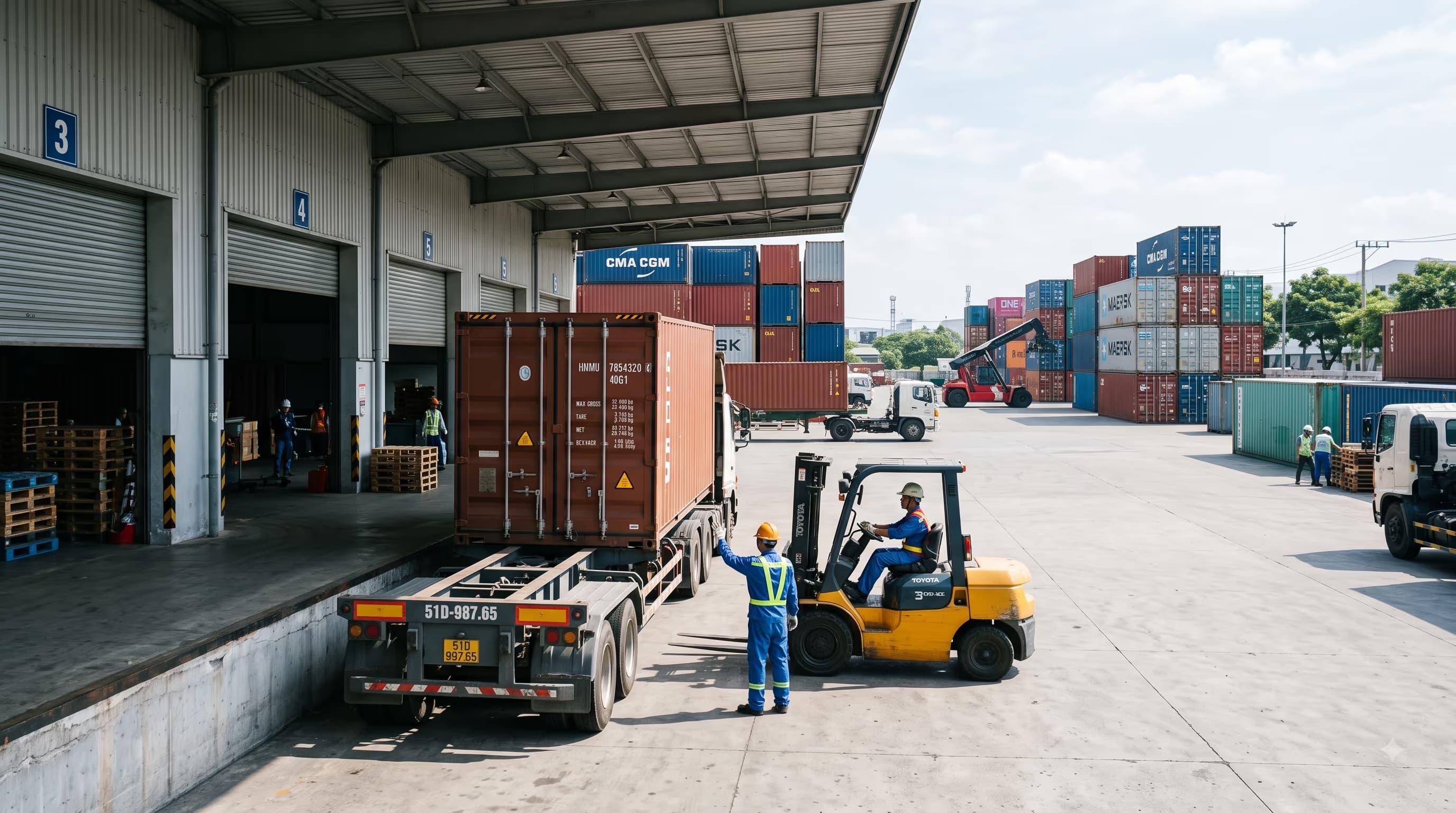
Your buyer asks for an FCA quotation, and the first question you face is simple but expensive: how far do my costs run, and who pays if the cargo is damaged on the way? FCA Incoterms (Free Carrier) is a delivery term under which the seller fulfils its delivery obligation once it hands over the good, cleared for export, to the carrier nominated by the buyer at a named place. This article will let you know where risk transfers, a comparison table against six other rules, and five mistakes that costs exporters money.
Before go deep dive into the detail. Think of the ICC's Incoterms as the baseline for any international deal, mapping out exactly who books the freight, pays the bills, and takes on the risk. The 2020 update splits the 11 rules across four letters (E, F, C, and D), grouping FCA under the 'F' terms. The first thing to remember is that FCA works for every mode of transport - road, rail, sea, air, and any combination of them.
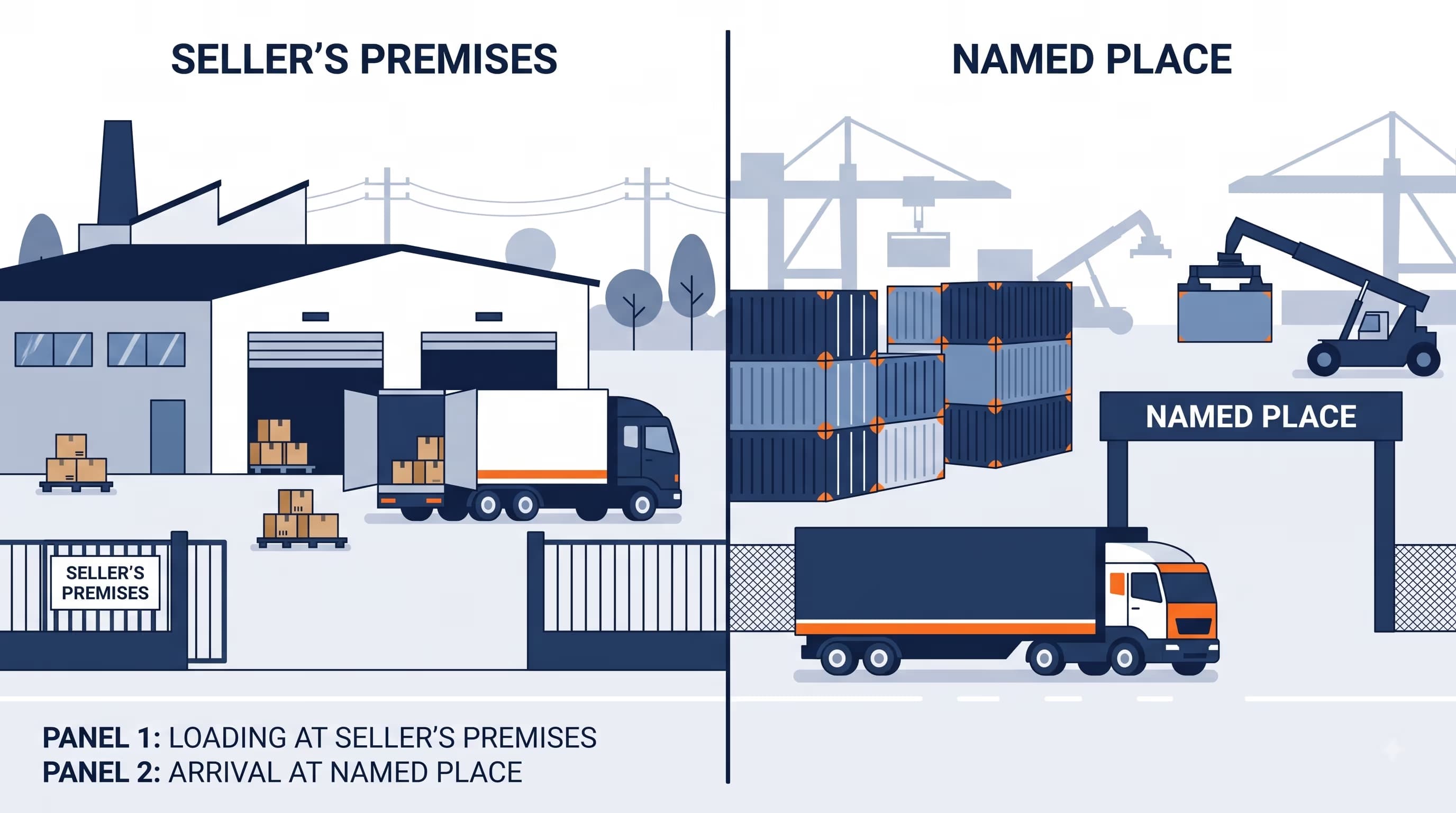
Scenario A is delivery at your own factory or warehouse. The buyer sends a truck, you load it, and that's it. Anything that happens before the goods settle on that truck bed is yours, including a pallet your own forklift driver drops. The trade-off is easy to live with: it is your yard, your equipment, your people, so the cost is one you can predict.
Scenario B is delivery anywhere else: a container terminal, an inland depot outside the city, a forwarder's warehouse, the air cargo terminal. Here your job ends when your truck arrives loaded and ready to be unloaded. You do not unload it.
This second case is where sellers slip. The truck is already sitting there, the buyer's forwarder is running late, and paying the lift-off charge yourself is the quickest way to get your driver back on the road. But that charge is the buyer's. Compiled tariffs from the terminals and depots around Hai Phong put one lift on a 40ft box anywhere from VND 1.25m to VND 1.8m, roughly USD 50 to 70, with the busier terminals near the top of that range. Small money on one shipment. Pay it on thirty and never invoice it back, and you have quietly handed over a month of margin.
Both cases come down to who is paying for the forklift and the two men running it. Which is why "FCA Ho Chi Minh City" is worthless in a contract. Write the street address, plus the gate or warehouse number if the site has more than one.
EXW, FCA and FOB get mixed up constantly, and almost always in the same two directions: a container shipment quoted FOB when it should have been FCA, or an EXW quote handed to a buyer who has no legal way to file the export declaration.
Rule | Seller handles export clearance? | When does risk transfer? | Mode |
|---|---|---|---|
EXW | No | Placed at the buyer's disposal, not loaded | Any |
FCA | Yes | Loaded onto the buyer's vehicle, or ready for unloading at the named place | Any |
FOB | Yes | On board the vessel | Sea and inland waterway only |
For most exporters shipping containers or air cargo, FCA is a safer choice than EXW or FOB, the two rules they reach for out of habit. There are four reasons: it works whichever way the goods travel, you know exactly when your responsibility ends, it matches how container shipping actually runs, and it changes the price you quote.
Your FCA price includes: the goods · export packing · export clearance costs and formalities · inland transport to the named place · loading, but only if delivery happens at your own premises.
Your FCA price does not include: main carriage · cargo insurance · terminal handling at origin · import duties, taxes and formalities at the other end.
Export clearance is the line item that moves most. What it costs you, and which permits or inspections you need before the declaration goes through, depends on the HS code your goods fall under.
Rule | Mode | Where risk transfers | Main carriage | Insurance obligation | Export clearance | Import clearance |
|---|---|---|---|---|---|---|
EXW | Any | At the named place, not loaded | Buyer | None | Buyer | Buyer |
FCA | Any | On hand-over to the nominated carrier | Buyer | None | Seller | Buyer |
FOB | Sea / inland waterway | On board the vessel | Buyer | None | Seller | Buyer |
CIF | Sea / inland waterway | On board the vessel | Seller | Yes (minimum ICC C) | Seller | Buyer |
CIP | Any | On hand-over to the first carrier | Seller | Yes (ICC A level) | Seller | Buyer |
DAP | Any | At destination, on the arriving vehicle, not unloaded | Seller | None | Seller | Buyer |
DPU | Any | At destination, unloaded | Seller | None | Seller | Buyer |
DDP | Any | At destination, not unloaded, cleared for import | Seller | None | Seller | Seller |
All rules per Incoterms® 2020 (ICC).
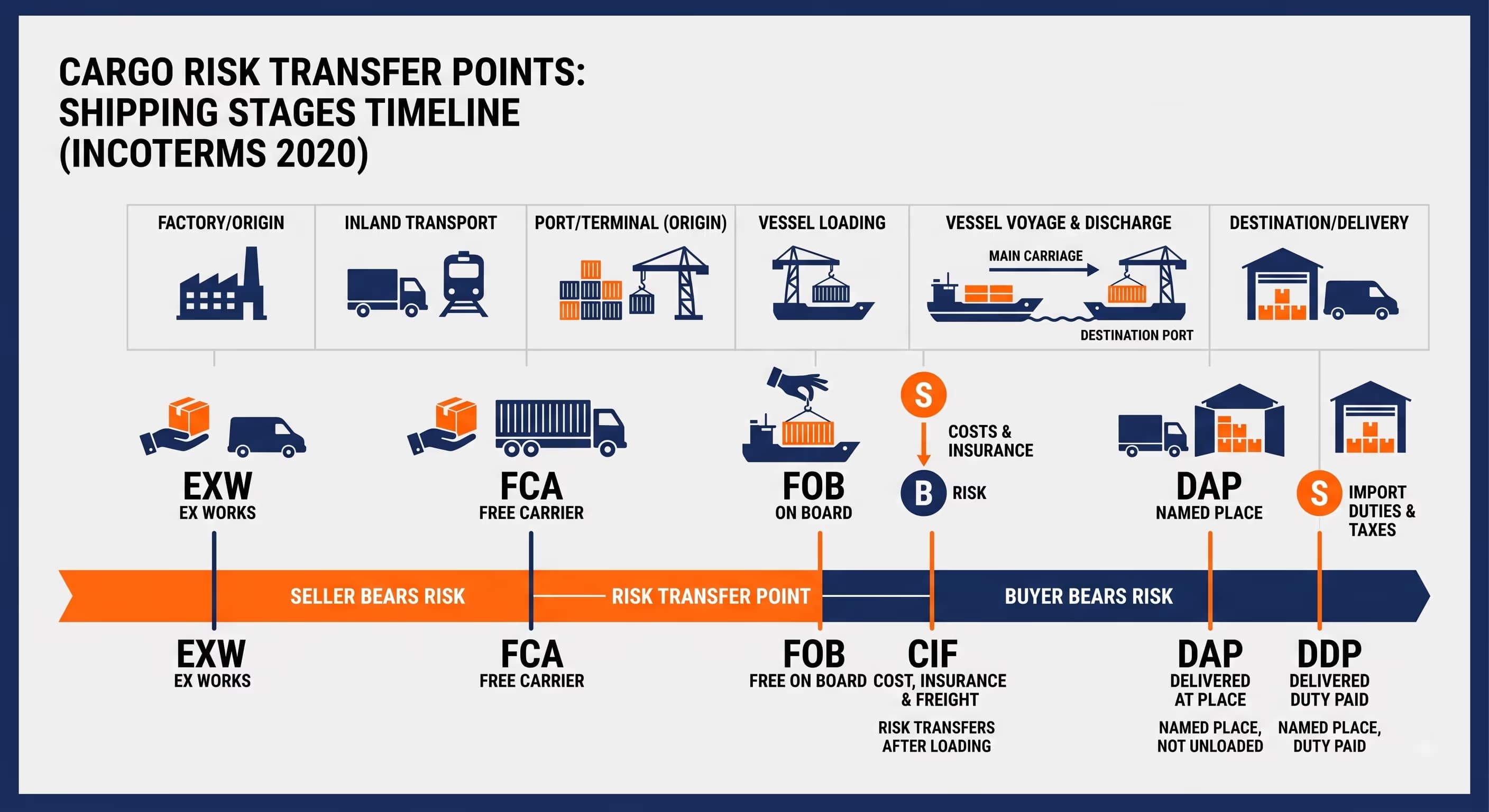
EXW asks almost nothing of you. You make the goods available at an agreed spot, still unloaded, and the buyer takes it from there: loading, export declaration, freight, all of it.
The export declaration is where this falls apart. Since January 2021 only a company established in the EU can be named as exporter on an EU declaration, and in the US the AES filer has to be physically located there. A buyer in Hamburg cannot file your Vietnamese export entry from Hamburg.
Loading is the smaller problem but it still catches people. Under FCA at your own premises you load the collecting truck. Under EXW you have no obligation to touch it, and that difference only becomes real when a driver is standing in your yard waiting.
Choose EXW when: the buyer is a trading house with its own licensed agent in your country who can file the export declaration under that agent's name.
FOB moves the handover on board the ship. You clear export, get the cargo to the quay, and the risk stays with you until it is loaded.
It only covers sea and inland waterway. Air, road, rail — FOB has nothing to say about them.
For containers the mismatch costs money. You gate in, lose all control, and still carry the risk for however many days the box waits. The ICC splits its rules into those for any mode and those for sea and inland waterway only, precisely because risk was passing at points that no longer matched how cargo actually moves.
Choose FOB when: you are shipping break-bulk or bulk that genuinely goes over the ship's rail, not a container.
CIF is a landed-port price. You book and pay the ocean freight to the destination port and you buy cargo insurance, but the risk still passes to the buyer back at origin, once the goods are on board.
The freight becomes yours to manage. Blank sailings, rolled containers, a rate that moves between quote and booking — that lands on your desk now, not the buyer's.
The insurance is thinner than most buyers assume. CIF only obliges you to Institute Cargo Clauses (C): fire, sinking, collision. Not theft. Not water damage in a port warehouse.
Choose CIF when: the buyer wants one delivered-port number and your freight rates beat what they can get themselves.
CIP does what CIF does, but for containers and air cargo. Carriage and insurance to the named destination are on you, while risk passes much earlier, at the point you hand over to the first carrier.
Incoterms 2020 raised the insurance floor here from ICC (C) to ICC (A), all risks. If you are still quoting CIP the way you did under the 2010 rules, you are buying less cover than the contract now requires.
Against FCA, you keep the freight booking and the policy. Against CIF, you are not locked into sea.
Choose CIP when: the buyer wants you to arrange both the freight and the cover, and the shipment is containerized or moving by air.
Under DAP you carry cost and risk the whole way to the named destination, with the goods sitting on the arriving vehicle, ready to come off. You do not unload them and you do not clear them for import.
Compare that to FCA and you are taking on the entire international leg. A container lost overboard, damaged during transshipment, sitting out a typhoon delay — under FCA none of that is yours anymore. Under DAP all of it is.
Import clearance is still the buyer's job. That one line is what keeps DAP different from DDP, and it is why DAP is the safer of the two for a seller with no entity in the destination country.
Choose DAP when: the buyer has little experience with international freight, or you want to quote a delivered price to win the order and you have run the route enough times to price the risk.
Worth knowing about its neighbor: DPU (Delivered at Place Unloaded) is DAP plus the unloading. Of the eleven Incoterms 2020 rules it is the only one that makes the seller unload, which sounds minor until the delivery point turns out to be a yard with no forklift and your driver is the one paying to solve it.
DDP sits at the opposite end from EXW. You deliver to the buyer's door with duty and import tax already paid, and there is nothing left for them to arrange.
You now have two customs clearances instead of one, and the second is in a system you do not work in daily.
Then there is the VAT. If you are not tax-registered in the destination country you cannot reclaim the import VAT — while the buyer, who is registered there, would have reclaimed it through their normal returns.
Choose DDP when: you have a legal entity or a proven customs broker in the destination country and you have checked that the import VAT comes back.

The problem. Under FCA, delivery is complete before the goods are anywhere near a ship. Your truck hands over at the CY, the inland carrier gives you a receipt, and that piece of paper says nothing about a vessel. Now open the letter of credit: it almost certainly asks for a bill of lading with an on-board notation. You cannot produce one, the bank refuses the presentation, and payment stalls while everyone argues over a document that describes something which had not happened yet when you delivered.
What Incoterms 2020 added. The 2020 edition wrote a fix into FCA article A6/B6: the parties may agree that the buyer will instruct its carrier to issue an on-board bill of lading to the seller once the goods are loaded, and the seller then tenders that document to the buyer, usually through the banks. It happens at the buyer's cost and risk. Two details worth knowing before you use it: the shipper named on that document should normally still be the buyer, not you, since you are not a party to the contract of carriage; and if the document is negotiable, an order bill in multiple originals, you have to hand the complete set back.
The limits.
There is a cleaner route. The ICC's own notes suggest asking the issuing bank to call for a "received for shipment" bill of lading rather than an on-board one. If the bank agrees, the problem disappears.
If none of that gives you confidence, price the shipment CPT or CIP instead, or move off letters of credit for that customer.
Most FCA disputes do not start with a misunderstanding of the rule. They start with a contract that left something unwritten.
1. Naming a vague place of delivery
What goes wrong: "FCA Ho Chi Minh City" means nothing. The city holds factory warehouses, an inland depot, a container terminal and an airport, and the inland transport and handling costs differ at every one of them. Whoever ends up paying gets decided by argument, not by contract.
How to fix it: Name the facility and the full street address, not the city.
FCA {warehouse name}, {full street address}, Vietnam, Incoterms® 2020
2. Assuming someone insured the cargo
What goes wrong: FCA puts no insurance obligation on either party. Both sides assume the other arranged it, and the container crosses the ocean with no cover at all. Nobody finds out until there is a claim.
How to fix it: Say who insures and to what level, in writing.
Cargo insurance to be arranged by the Buyer, minimum Institute Cargo Clauses (A), from the named place of delivery.
If the buyer wants you to arrange the cover instead, use CIP rather than FCA.
3. Paying by L/C without agreeing the on-board document
What goes wrong: Your inland receipt has no on-board notation, the bank refuses the presentation, and you are either amending the L/C or waiting weeks for money you have already earned.
How to fix it: Write the A6/B6 on-board mechanism into the sales contract, and confirm with the shipping line that it will actually issue.
The Buyer shall instruct its carrier to issue to the Seller a bill of lading bearing an on-board notation, at the Buyer's cost and risk, per FCA A6/B6, Incoterms® 2020.
4. Mixing up export and import clearance
What goes wrong: A shipment sits at destination because a permit nobody applied for turns out to be mandatory. The rule itself is simple. Under FCA export clearance is always yours, import clearance always the buyer's. But the documents around it get lost between the two. Origin is the one people miss: under every rule except EXW the seller is the exporter and therefore the party making the origin statement, which matters when the buyer is claiming a preferential tariff.
How to fix it: List the documents by name and by owner, rather than relying on the rule to cover it.
Seller to provide: export declaration, Certificate of Origin (Form {X}), phytosanitary certificate. Buyer to obtain: import licence and any product-specific approvals at destination.
5. Leaving out the Incoterms version
What goes wrong: "FCA Cat Lai" does not say which edition applies. Incoterms 2020 is the current edition, but 2010 has not been withdrawn and parties remain free to contract on it. In a dispute each side cites whichever version helps them.
How to fix it: Write the rule in full, every time, including the year.
FCA {named place}, Incoterms® 2020
FOB only works for sea and inland waterway transport, and risk passes once the goods are on board the vessel. FCA works for every mode, and risk passes earlier, as soon as the goods are handed to the nominated carrier at the named place. For containerised cargo, FCA is the correct choice.
Neither party is obliged to insure. Because risk passes to the buyer at the point of delivery, the buyer is the party that should cover the international leg, while you only need cover for the inland leg up to the named place.
Yes, and it is the most suitable rule for air cargo. The named place is usually the warehouse of the airline or of the freight forwarder nominated by the buyer at the airport of departure.
Almost always, if you are the exporter. You need to appear on the export customs declaration to qualify for zero-rated VAT and to recover input VAT, and FCA at your own premises covers the same practical workload as EXW while keeping that obligation with you.
Incoterms® 2020 added an optional mechanism for obtaining a transport document with an on-board notation, which helps sellers paid by letter of credit. The 2020 edition also presents each party's obligations more clearly and groups all cost allocation into a single article.
Getting FCA right comes down to three things: it works for any mode of transport, export clearance is always the seller's job, and the named place has to be specific enough that nobody can argue about it later. Write it out in full every time, down to the address: FCA [specific place], Incoterms® 2020. What that export clearance actually costs you, and which permits sit behind it, depends on the HS code your goods fall under, so check yours before you quote.
This article is for general guidance only. Specific contract terms should be checked against your own agreement and a qualified trade advisor.
Enter your email to receive the latest trade insights, guides, and HS-code explainers from EximAgent Blog.