Export Import
How to Calculate Import Duty Using an HS Code
Jul 24, 2026
Technology
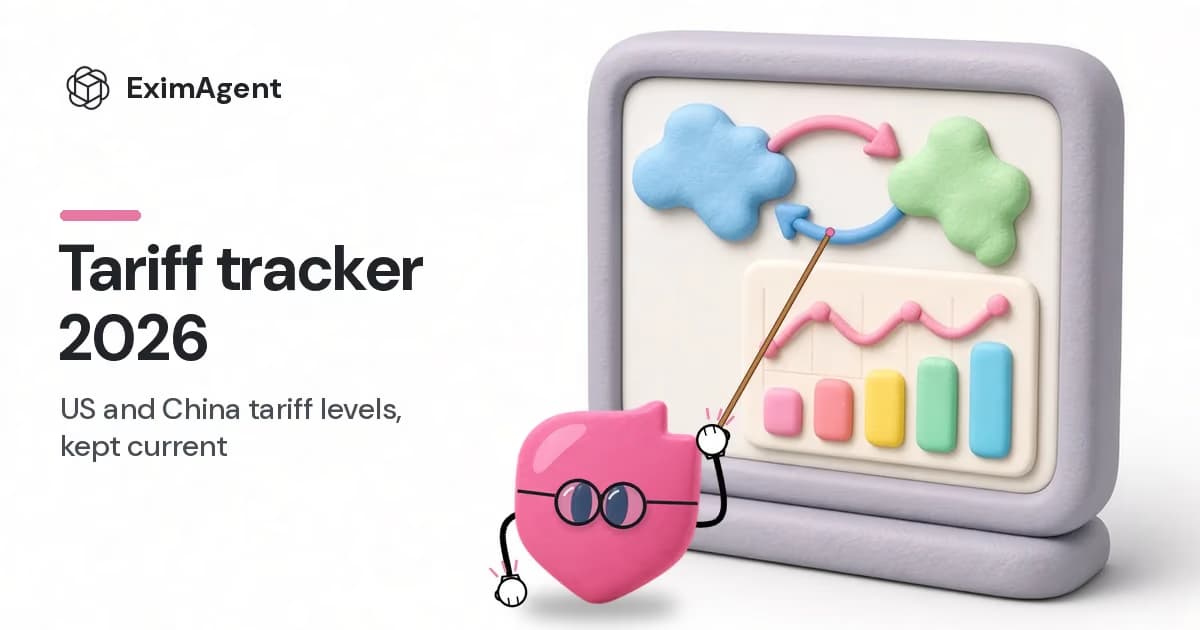
US tariff layers on Chinese goods as of October 2026: Section 301, the 12.5% forced-labor duty, and what ended with IEEPA and Section 122.
May 18, 2026Last updated October 12, 2026By Davos Pham6 min readView as Markdown
As of October 12, 2026, US tariffs on goods from China are made up of the base HTSUS rate, plus Section 301 duties on listed products (7.5% to 100% depending on the list and product), plus a 12.5% Section 301 duty on most Chinese goods that took effect on July 24, 2026. The IEEPA tariffs of 2025 no longer apply after the Supreme Court's February 20, 2026 ruling, and the 10% Section 122 surcharge that replaced them expired on July 24, 2026.
This page tracks the main US tariff layers on Chinese-origin goods in 2026, with dates and the primary source for each. Rates below are additional to the base HTSUS rate. Additional duties (e.g. HTS Chapter 99) may apply; check the current HTS or a customs broker.
Tariff layer | Rate on China-origin goods | Status on Oct 12, 2026 | HTS heading | Source |
|---|---|---|---|---|
IEEPA tariffs (2025) | Varied | Not in force; Supreme Court ruled Feb 20, 2026 | n/a | Learning Resources v. Trump |
Section 122 surcharge | +10%, all countries | Expired 12:01 a.m. EDT Jul 24, 2026 | 9903.03.01 | Proclamation, FR 2026-03824; CBP CSMS #67844987 |
Section 301 (forced labor action) | +12.5% | In force since 12:01 a.m. ET Jul 24, 2026 | 9903.05.31 | USTR, FR 2026-15181 |
Section 301 List 1, 2 and 3 | +25% | In force | 9903.88.01, .02, .03 | USITC HTS |
Section 301 List 4A | +7.5% | In force | 9903.88.15 | USITC HTS |
Section 301 four-year review increases | 25% to 100% on named products | In force; see table below | 9903.91 series | USTR, FR 2024-21217 and FR 2024-29462 |
Each rate in this table is additional to the base duty. Additional duties (e.g. HTS Chapter 99) may apply; check the current HTS or a customs broker.
In Learning Resources, Inc. v. Trump (decided with Trump v. V.O.S. Selections, Inc.), the Supreme Court held that the International Emergency Economic Powers Act (IEEPA) does not authorize tariffs. CBP stopped collecting IEEPA duties on goods entered on or after 12:00 a.m. ET February 24, 2026 (CSMS #67834313). Refunds run through CAPE (Consolidated Administration and Processing of Entries) in ACE: the importer of record or its broker files a CAPE Declaration in the ACE Portal, and CBP refunds IEEPA duties with interest. Rollout is phased, so check CBP's IEEPA duty refunds page for which entries qualify.
A presidential proclamation under Section 122 of the Trade Act of 1974 imposed a 10% ad valorem surcharge on imports from all countries for 150 days, effective February 24, 2026 (Federal Register 2026-03824). CBP applied it under HTS 9903.03.01 through 12:01 a.m. EDT on July 24, 2026, with product exclusions in 9903.03.02 to 9903.03.11. The surcharge is no longer in force.
USTR's forced-labor Section 301 action, which covers 60 economies (Federal Register 2026-15181, published July 28, 2026), imposed an additional 12.5% duty on products of China from 12:01 a.m. ET on July 24, 2026, under HTS 9903.05.31. Products listed in 9903.05.85 to 9903.05.92 are excluded, and goods subject to Section 232 duties are exempt.
USTR opened the second four-year review of the 2018 Section 301 China tariffs (Federal Register 2026-08806, May 6, 2026) and published a continuation of those actions on October 7, 2026 (Federal Register 2026-20510). The List 1 to 4A duties remain in place while the review runs.
The first four-year review (USTR memorandum, Federal Register 2024-11193, with final modifications in FR 2024-21217 and FR 2024-29462) raised Section 301 rates on these product groups. The year shows when each increase took effect or was scheduled to take effect. Polysilicon, wafers and tungsten products were added by FR 2024-29462, effective January 1, 2025.
Product group | Section 301 rate | Effective year |
|---|---|---|
Electric vehicles | 100% | 2024 |
Semiconductors | 50% | 2025 |
Solar cells | 50% | 2024 |
Lithium-ion EV batteries | 25% | 2024 |
Lithium-ion non-EV batteries | 25% | 2026 |
Natural graphite and permanent magnets | 25% | 2026 |
Certain critical minerals | 25% | 2024 |
Polysilicon and wafers | 50% | 2025 |
Certain tungsten products | 25% | 2025 |
Certain steel and aluminum products | 25% | 2024 |
Ship-to-shore cranes | 25% (2024); 100% scheduled from Nov 10, 2026 | 2024 / 2026 |
Syringes and needles | 100% | 2024 |
Certain facemasks | 50% (from 25%) | 2026 |
Medical gloves | 100% (50% in 2025) | 2026 |
Ship-to-shore cranes contracted before May 14, 2024 and entered before May 14, 2026 were excluded from the 25% rate (9903.91.09 and 9903.92.10). The 100% line is a separate Section 301 action on China's maritime, logistics and shipbuilding sectors: USTR imposed it on ship-to-shore gantry cranes (9903.91.14) and intermodal chassis (9903.91.12) in FR 2025-19568, then suspended it until November 10, 2026 in FR 2025-19873.
Each rate is additional to the base duty and applies only to the HTS subheadings named in the notices. Additional duties (e.g. HTS Chapter 99) may apply; check the current HTS or a customs broker.
Every layer above is applied by HTS subheading, so start from the correct 10-digit code. See how to classify goods using HS codes.
Check whether your subheading appears in the Section 301 lists (9903.88 series), the four-year review increases (9903.91 series) and the forced labor action (9903.05.31) or one of its exclusions.
Goods subject to Section 232 duties are exempt from the 12.5% forced labor duty, so the Section 232 status of the product changes the total.
Add base duty, each additional duty and US fees such as the merchandise processing fee. How to calculate import duty walks through the math.
Tariff layers changed several times in 2026. Pricing from an old rate is the problem described in stop quoting with stale tariffs.
In 2025, Chinese goods paid base duty, Section 301 duties and IEEPA tariffs. In 2026, IEEPA tariffs ended after the February 20 Supreme Court ruling, a 10% Section 122 surcharge applied from February 24 to July 24, and a 12.5% Section 301 forced labor duty applied from July 24. Section 301 List 1 to 4A duties (7.5% to 25%) and the strategic product rates (25% to 100%) continued.
Yes, through CAPE (Consolidated Administration and Processing of Entries) in ACE. The importer of record or its broker files a CAPE Declaration in the ACE Portal, and CBP refunds IEEPA duties with interest. Rollout is phased, so check CBP's IEEPA duty refunds page for which entries qualify.
No. Products in 9903.05.85 to 9903.05.92 are excluded, and goods subject to Section 232 duties are exempt.
No. CBP applied it through 12:01 a.m. EDT on July 24, 2026.
Check duties by HS code. Start from the code, then review each tariff layer for your product. Free to start. Open HS code lookup
EximAgent Research writes practical guides on finding buyers, reading trade data and checking HS codes, tariffs and sanctions.
Enter your email to receive the latest trade insights, guides, and HS-code explainers from EximAgent Blog.