Export Import
HS Code Lookup Tool: Find Codes, Tariffs and Buyers
Jul 22, 2026
Logistics
How to classify goods with HS codes in six steps: describe the product, find the chapter, apply the GRIs, confirm the national digits and record your reasoning.
June 1, 2025Last updated October 13, 2026By Davos Pham5 min readView as Markdown
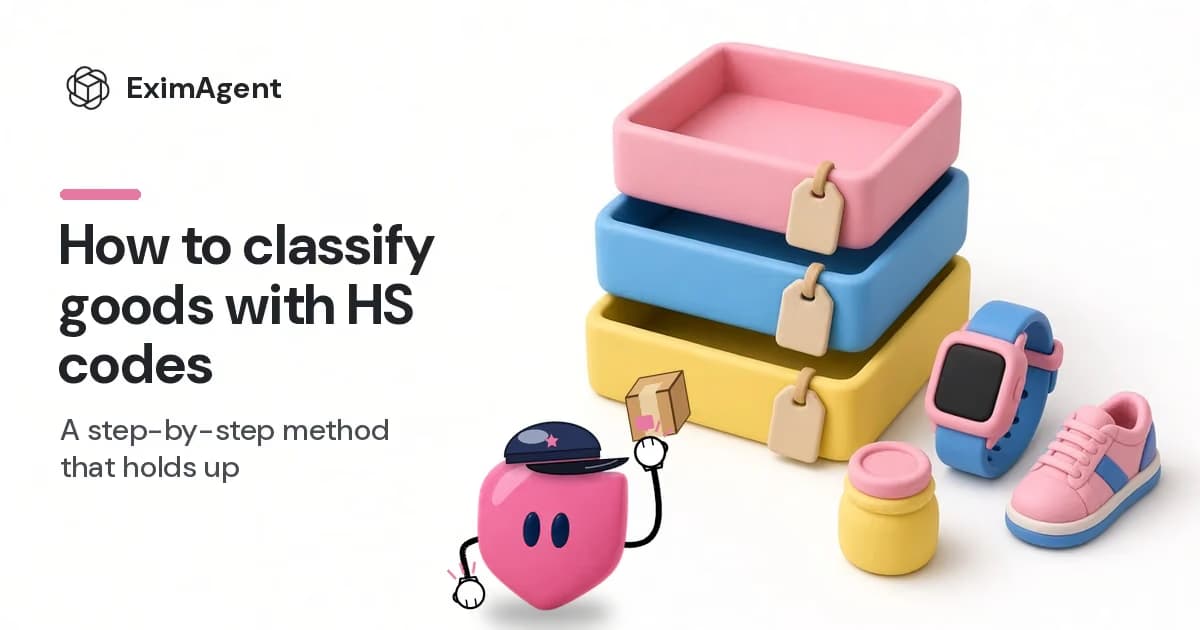
To classify goods with HS codes accurately, describe the product by what it is made of, what it does and how it is presented, then work down the Harmonized System from section to chapter to heading to subheading using the General Rules of Interpretation (GRIs), and confirm the final digits in the destination country's own tariff.
The Harmonized System (HS) is maintained by the World Customs Organization (WCO) and is used by more than 200 countries and economies. The first six digits are shared internationally; each country adds its own digits for duty and statistics. That split is where most classification errors start.
Customs authorities classify goods on their objective characteristics at the time of import, not on how the seller markets them. The facts that usually decide the code are:
If you cannot answer these four points from your spec sheet, stop and collect the data before you look up any code.
Use the commercial invoice name plus material composition, function, model number and packaging. "Smartwatch" is not enough; "wrist-worn device with opto-electronic display, base-metal case, Bluetooth connection to a phone" is something a classifier can work with.
The HS is arranged in 21 sections and 97 chapters (chapter 77 is reserved), moving roughly from raw materials to finished goods. Read the section and chapter notes first: they include and exclude goods explicitly and override heading titles.
GRI 1 says classification is determined by the terms of the headings and any relative section or chapter notes. Most products are settled here. Only move to GRIs 2 to 6 when GRI 1 does not resolve the question (incomplete articles, mixtures, composite goods, sets).
When two headings both seem to fit, GRI 3 applies in order: the most specific description wins; then the component that gives the product its essential character; then the heading that occurs last in numerical order.
Compare subheadings at the same level only (GRI 6). Then open the destination tariff for the national digits. In the US that is the Harmonized Tariff Schedule (HTSUS), published by the US International Trade Commission. Example from the current HTSUS: green tea in immediate packings of 3 kg or less is subheading 0902.10, and the flavored version is 0902.10.10.
Search for binding rulings on similar goods (US Customs rulings are searchable in the CBP CROSS database), and keep a short file: product facts, the headings you considered, the GRI you applied and the final code. If the product is new to you or high-value, ask a licensed customs broker or request a binding ruling.
In the US, the importer of record is legally responsible for declaring the correct classification and value, even when a broker files the entry or a supplier suggested the code. Use supplier codes as a starting point and verify them. For exports, the exporter is responsible for the export classification (Schedule B for statistics and, separately, the export control classification).
Marketing names hide material and function. Two products sold as "organizer" can fall in different chapters depending on whether they are plastic, textile or metal.
Six digits are only the international part. Duty rates and import requirements sit at the national level, so a correct 6-digit code can still lead to a wrong duty.
The HS is normally revised every five years. HS 2022 is in force now, and the WCO has adopted HS 2028, which enters into force on January 1, 2028. National tariffs also change during the year.
The base rate in a tariff column is not always the full duty. In the US, additional duties under HTS Chapter 99 (for example Section 301 on certain goods from China) are added on top. Additional duties (e.g. HTS Chapter 99) may apply; check the current HTS or a customs broker.
For the cost side of a wrong code, see what happens if you use the wrong HS code.
Partly. Automated HS code classification tools match a product description against tariff text and past rulings and return candidate codes. They speed up steps 1 to 5, but a person still has to check the notes, the GRI reasoning and the national digits before filing. Our HS code lookup tool guide shows that review workflow, and HTS vs HS code explains the national digits.
Describe the product by material, function, form and presentation, find the chapter, apply GRI 1 to choose the heading, use GRI 3 if two headings compete, then confirm the national digits in the destination tariff.
It is guidance from a customs broker, consultant or customs authority on which code applies. In the US, a binding ruling from CBP is the formal version and applies to the specific goods described in the request.
The importer of record for the import declaration, and the exporter for export filings. Brokers and suppliers can help, but the legal responsibility stays with the declarant.
Check the section and chapter notes first. If they do not decide it, use GRI 3: the most specific heading, then essential character, then the last heading in numerical order.
Treat automated results as candidates. Verify the chapter notes, the GRI reasoning and the national digits, and keep a record of why you chose the code.
Look up an HS code for your product. Describe the product and get candidate codes to check against the destination tariff. Free to start. Open HS code lookup
EximAgent Research writes practical guides on finding buyers, reading trade data and checking HS codes, tariffs and sanctions.
Enter your email to receive the latest trade insights, guides, and HS-code explainers from EximAgent Blog.