Export Import
How to Calculate Import Duty Using an HS Code
Jul 24, 2026
Export Import
Break down landed cost for a trade lane: product, freight, duty, taxes and fees. Ask Compliance for inputs. See pricing for applicable charges.
November 10, 2026By Juno, EximAgent Research10 min readView as Markdown
A landed cost breakdown reconciles the supplier’s quoted amount with the additional costs needed to reach a defined destination endpoint. Count included charges once, then show gross destination outlay, economic cost after confirmed tax recovery (if any), and who remits separately. For how a single duty line is looked up and calculated, see How to calculate import duty.
If you price or buy on a fixed trade lane — known origin, destination, and product — you need a credible landed cost before you lock a customer or PO price. This guide is for sales ops, procurement, and export compliance teams building that number from pieces you can check, not from a single guessed duty percentage.
A thin quote (product plus freight, or duty alone) often leaves out destination charges. The goal here is a practical calculating worksheet for the lane: which cost buckets to list, how Incoterms affect who pays which line, how to keep customs/tax bases separate from costs, and where to look up duty without inventing a rate.
Landed cost is the all-in economics of getting goods to an agreed place — often the buyer’s warehouse or port of entry — after product price, international movement, and import-side charges. Exact buckets depend on the sales contract and the destination country’s rules. They are not all due on every shipment. Keep your chosen cost endpoint separate from the Incoterm’s delivery / risk-transfer point when those differ.
Incoterms® rules from the U.S. International Trade Administration clarify which party pays for and manages shipment, insurance, documentation, customs clearance, and related logistics. Specify the Incoterms® version and the exact named port or place. Incoterms do not set the duty rate or replace a destination tariff schedule.
Useful cost buckets to list (qualitative — no fixed rates):
Use this as a checklist of candidate lines, not as a claim that every fee is mandatory for every importer.
Supplier prices under different Incoterms already allocate some costs. A CIF quotation can include carriage and insurance to the named destination port; other terms allocate different costs. Record the agreed Incoterms® version and exact named port or place, check the supplier’s actual inclusions, and add each charge only once. Keep your chosen landed-cost endpoint separate from the Incoterm’s delivery/risk-transfer point.
Keep three views on the same worksheet when they differ:
Where an import tax may be recoverable as input tax or similar, separate gross cash outlay from economic cost after recovery. Confirm recoverability with current destination or national tax guidance or your accountant — for EU context see the Commission’s ARCHIVED explanatory VAT-deduction guidance (not evidence for every current national recoverability rule). Do not assume every VAT/GST amount is a permanent cost, and do not assume it is always recoverable.
Import duty depends on the full national tariff line, the destination’s customs value rules, the country of origin under the rules that apply to that entry, and any additional measures on that product and origin. It is not a single memorized percentage.
The supplier invoice is not automatically the customs value, and the customs value is not the landed-cost total. Record the customs-value adjustments and tax base required by the destination before calculating duty or import tax. Do not add the valuation or tax base itself as another cost line. Specific or compound duties may require quantity or weight — use the applicable schedule’s method rather than assuming every duty is ad valorem.
For valuation orientation: WTO Customs Valuation (transaction value and adjustments) and, for U.S. appraisement practice, 19 CFR 152.103. For U.S. import rates, use the Harmonized Tariff Schedule (HTS) from the U.S. International Trade Commission. CBP’s basic import and export hub orients U.S. process; it is not a substitute for the schedule line for your goods.
Other duties or trade remedies can sit on top of a general rate. Use the official schedule or a licensed broker for the live line as of the intended entry date. For a duty-focused walkthrough, see How to calculate import duty.
Preferential or program rates can change the duty when the shipment qualifies. Qualification follows the agreement’s own origin rule and proof requirements — not “ship-from” alone.
Country of origin for duty and preference is defined by the rules that apply to that product and claim (destination non-preferential rules, and — if you claim preference — the specific trade agreement’s origin rule and documentation). For orientation see the WCO Rules of Origin FAQ.
Do not treat “last port of loading” as origin. Preferential claims need the agreement’s rule and the required proof. When unsure, confirm with your broker or the competent authority before you quote a preferential rate.
Copy this into a sheet. Leave rate and amount cells blank until you have an official or quoted source. No sample tariff rates or worked totals are provided here.
Field | Your notes |
|---|---|
Origin / export location / destination / mode | |
Planned entry date | |
Incoterms® rule + version + exact named port/place | |
Cost endpoint used in this estimate (may differ from risk-transfer point) | |
Shipment quantity + unit | |
Quote currency | |
Reporting currency | |
FX rate / source / date / basis (commercial vs customs/tax if different) | |
Quote expiry / as-of date | |
Exclusions / unresolved inputs / reserve (rationale only — not a government fee) |
# | What to record | Amount (reporting ccy) | Already included? (Y/N / in which line) | Payer | Source + date checked | Est. or actual |
|---|---|---|---|---|---|---|
1 | Product description (material, function, form, packing) | — | — | — | ||
2 | Candidate full national tariff code | — | — | — | ||
3 | Incoterm + named place (confirm vs header) | — | — | — | ||
4 | Supplier quoted amount (quote currency → reporting ccy) | |||||
5 | Origin under the applicable rule (not ship-from) | — | — | — | ||
6 | Destination country / entry path | — | — | — | ||
7 | Add-on freight / insurance only if not already in supplier price | |||||
8 | Duty — look up; do not invent % · note customs-value base used (base ≠ cost line) | |||||
9 | Destination tax — look up; note tax base; flag recoverability | |||||
10 | Government fees / brokerage / inland — if applicable to this shipment and not already included; record payer separately | |||||
11 | Gross destination outlay (sum only non-duplicated cost lines 4+7+8+9+10…) | — | — | formula | ||
12 | Your remittance total (sum only lines your company pays) · optional: economic cost after confirmed recovery | — | — | formula |
Formulas (blank inputs only — no invented outputs):
Until tariff lines and official rates are confirmed, any number is a draft for internal discussion, not a customer commitment.
For classification help: HS code lookup guide, HS code directory, HTS vs HS code.
Compliance is EximAgent’s AI teammate for export compliance checks. On a landed-cost lane it can:
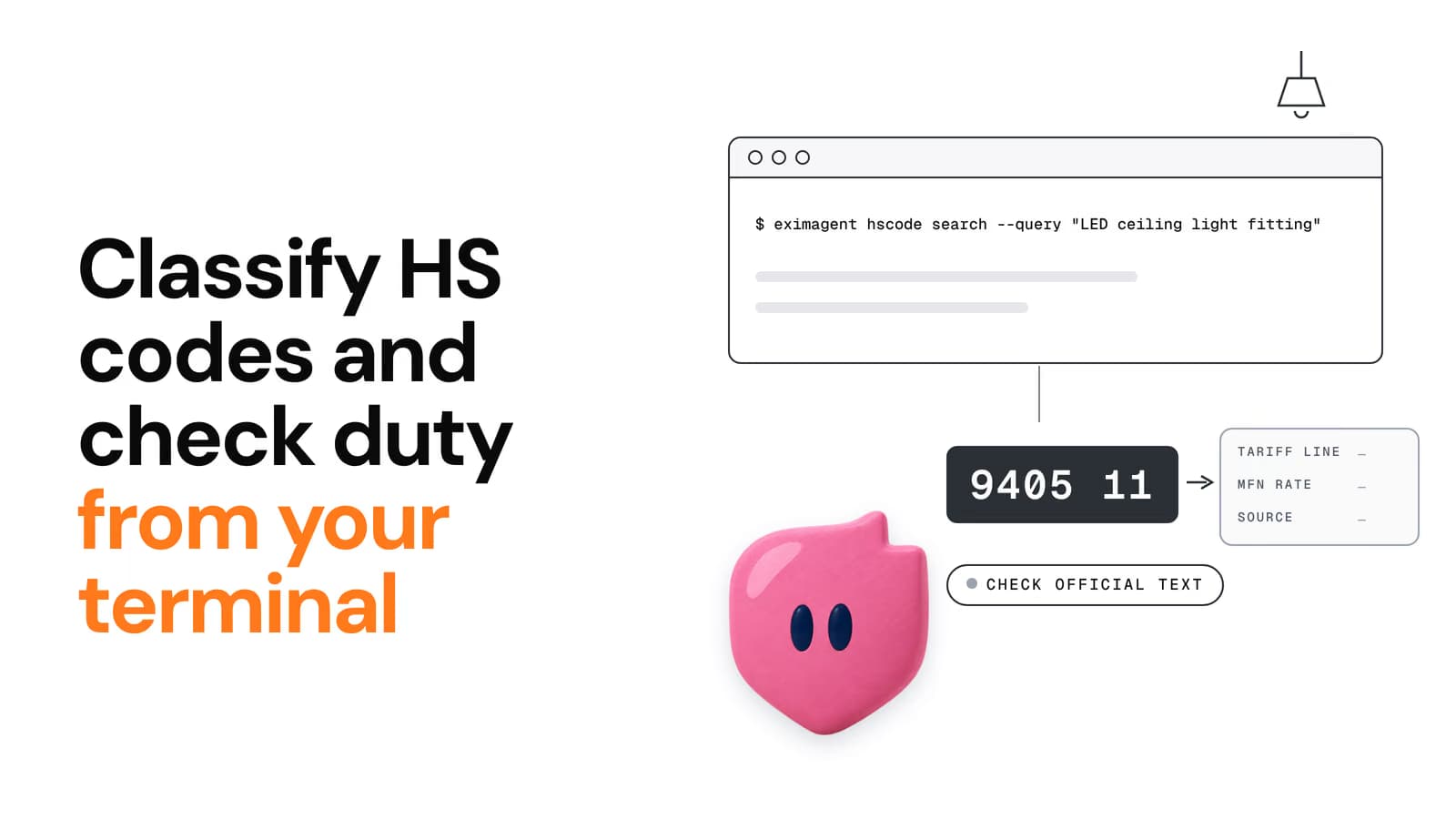
Work in chat on eximagent.ai, the CLI (eximagent tariff …, eximagent hscode search …), or the MCP connector docs. See pricing for applicable charges.
Limits:
Ask Compliance for landed-cost inputs for my lane. See pricing for applicable charges.
Wrong codes create duty, delay, and penalty risk — see What happens if you use the wrong HS code.
Is landed cost the same as import duty?
No. Duty is one component. Freight, insurance, destination taxes, and other charges can matter as much or more, depending on the lane and term. Use the duty guide for rate mechanics; use this page for the full worksheet and quote basis.
Do I always pay every fee in the checklist?
No. Which costs you remit depends on the Incoterm, the contract, and destination rules. Still list material destination costs when you judge whether the deal works.
Can Compliance give me a final customer price?
No. It can help with classification and duty or lane inputs. Your price still needs freight quotes, tax treatment, and your margin policy. See pricing for applicable charges.
Where do I look up U.S. duty lines?
Start with the HTS and CBP’s import and export resources, or your broker.
Ask Compliance for landed-cost inputs for my lane. See pricing for applicable charges.
Continue with How to calculate import duty and the HS code directory.
EximAgent Research writes practical guides on finding buyers, reading trade data and checking HS codes, tariffs and sanctions.
Enter your email to receive the latest trade insights, guides, and HS-code explainers from EximAgent Blog.