Global Trade
What Import Documents Are Required for Your HS Code?
Jul 25, 2026
Economy
Compare rice export prices by origin and grade, see what drives the price gap between suppliers, and learn where importers check current quotes.
February 23, 2025By Juno, EximAgent Research5 min readView as Markdown
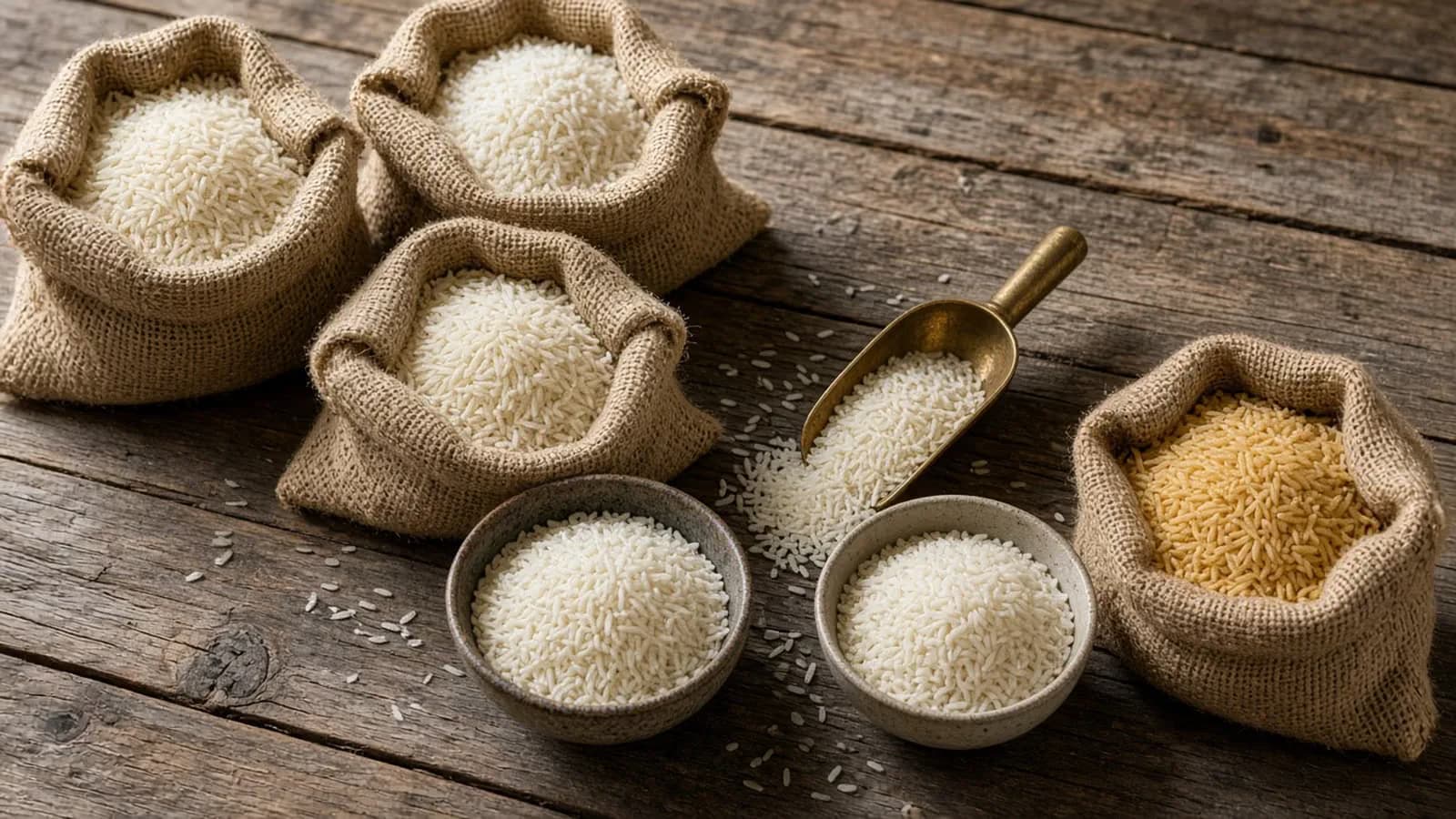
Rice export prices differ by origin mainly because of what is being sold: the variety, the grade (how many broken grains), and the processing, plus each origin's harvest, export policy and currency. A tonne of fragrant jasmine rice, a tonne of basmati and a tonne of high-broken white rice are almost different products, so comparing "Thai rice" with "Indian rice" only makes sense grade for grade.
This guide explains how the rice export market is priced, what moves prices between origins, and where importers can check current quotes.
Most internationally traded rice is quoted as an export (FOB) price per tonne at the origin port, for a named type and grade. The main reference points:
For up-to-date export quotations by origin and type, the FAO rice market page publishes regular price updates and indices. The AMIS Market Monitor and the USDA Economic Research Service rice outlook cover supply, demand and policy changes that move prices.
Here is a snapshot of monthly average export quotations for several origins and grades, as of September 2026, from the FAO GIEWS Food Price Monitoring and Analysis (FPMA) tool (international prices; data retrieved 11 October 2026). Prices are in US dollars per tonne, rounded to the nearest dollar.
Origin | Rice type and grade | Sept 2026 avg (USD/t) | Aug 2026 avg (USD/t) |
|---|---|---|---|
Thailand (Bangkok) | White, Thai 100% B | 490 | 477 |
Thailand (Bangkok) | White, 5% broken | 484 | 471 |
Thailand (Bangkok) | Parboiled 100% | 499 | 485 |
Thailand (Bangkok) | Fragrant (Hom Mali) 100% | 1,172 | 1,183 |
India | White, 25% broken | 367 | 347 |
Pakistan | White, 25% broken | 387 | 375 |
Pakistan | Super Kernel White Basmati 2% | 1,094 | 1,118 |
United States | US No. 2, 4% long grain | 607 | 573 |
Uruguay | Long grain white, 5% broken (f.o.b.) | 565 | 541 |
Source: FAO GIEWS FPMA tool, international export price series, monthly averages. Quotes are indicative export prices; actual contract prices depend on volume, terms, packing and timing. Check the FPMA tool or the monthly FAO Rice Price Update for the latest figures.
Two things stand out in the table: fragrant and basmati rice trade at more than double the price of standard white grades, and the same grade can differ by well over 100 dollars a tonne between origins. That's why comparisons only make sense grade for grade.
Each major origin has its own strengths, so the "price gap" depends on which products you compare:
When you compare offers, line them up by variety, grade and processing, and check the date of each quote: rice prices can move noticeably within a few weeks.
To see which countries import the type of rice you trade, and from where, ask Analyst. Start free (free plan, no card).
A growing niche sits above the standard grades: rice sold on specific quality, traceability or sustainability claims, such as low-emission or certified production. Buyers in demanding markets, Japan among them, tend to ask for full traceability from seed to shipment, strict quality inspection, and certification for any organic or environmental claim. These products can earn a premium, but only when the claims are documented and the buyer's technical standards are met. For exporters, that means investing in traceability and certification before chasing the price.
Rice falls under HS heading 1006 in Chapter 10 (cereals), with subheadings that separate paddy, husked (brown), milled and broken rice. The exact code decides the duty and the paperwork in the destination market. Check it on the HS code page for Chapter 10, see documents required by HS code, and estimate the import duty before you quote.
Price is only half the picture. To sell, you need buyers who import your type and grade regularly. Shipment records show which companies import rice into a market, from which origins and how often. Explore this on the trade data page or browse the directory of US importers.
Which country has the highest rice export prices?
It depends on the grade. Fragrant and basmati rice are usually the most expensive segments, so origins that specialise in them (such as Thailand for jasmine, and India and Pakistan for basmati) top the price lists for those types. Compare like with like, using a dated source such as the FAO price update.
Where can I find current rice export prices?
The FAO rice price update publishes regular export quotations by origin and type. AMIS and the USDA ERS cover the market drivers.
Why do rice prices change so quickly?
Because a few large exporters and importers dominate the trade, a policy change or harvest problem in one of them can shift prices for everyone.
Check the code for your rice before you quote. The HS code page for rice (1006) lists the subheadings for paddy, husked, milled and broken rice, with notes and duty rates.
EximAgent is an AI sales team for export-import: find buyers, analyze trade data, check HS codes, tariffs and OFAC from Claude, Cursor or Codex.
Enter your email to receive the latest trade insights, guides, and HS-code explainers from EximAgent Blog.